
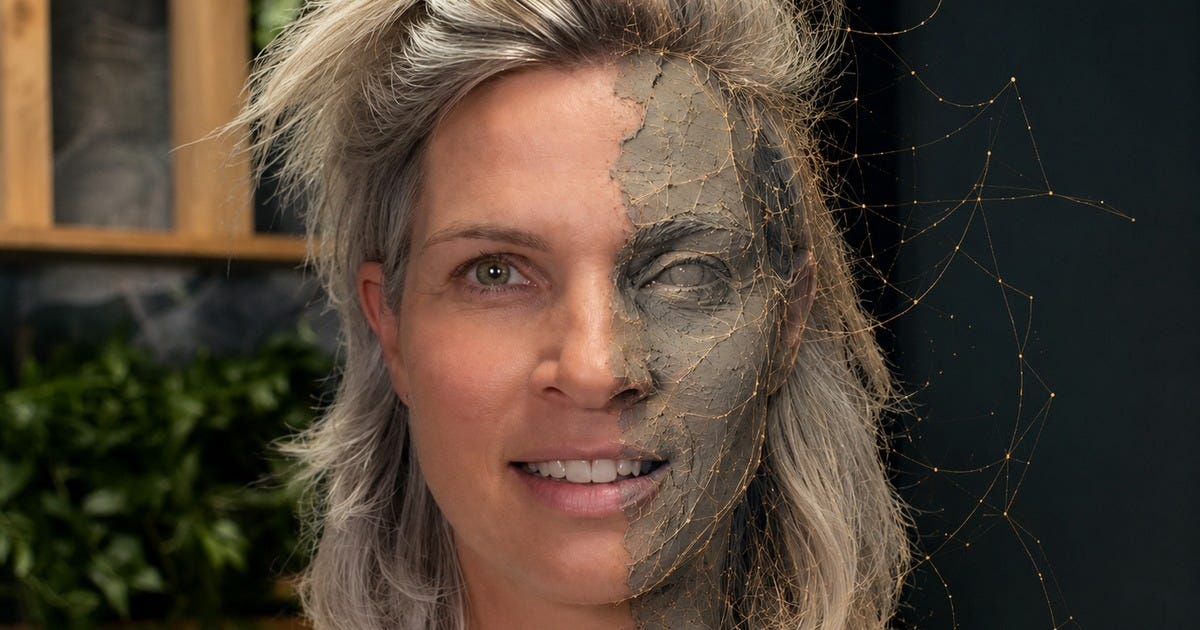
Once I watched a sculptor press clay onto an old human skull, muscle by muscle, to bring back a face that had been gone for centuries.
What struck me wasn’t the science. It was her hands. They seemed to know things her eyes could not tell her: where a cheek would have curved, how this particular person might have looked. She was not thinking her way to a face. She was touching her way there. Something passed between her hands and the clay that never fully passes through the eye.
Then I watched that same craft cross into software. The skull scanned into a computer, the muscles drawn on digitally, and a device called the Phantom that let a hand carve and smooth and tug at the digital clay and actually feel it push back through a stylus, as if it had weight and give. The oldest gesture we have, the touching hand, reaching into the newest medium. And here was the strange, beautiful part: the touch survived the crossing. The hand could still feel its way, even inside the machine.
A paper I wrote more than a decade ago, during my master’s, was about exactly that. I called it Touching Knowledge, and I still love the title, because touch is such a human thing, and because it holds the whole idea in two words: that some knowledge does not arrive through the eye at all. It arrives through the hand.
What I was really asking, underneath the clay, was older and larger than any tool. Were art and science ever truly separate to begin with?
We treat them now as opposites. Science produces truth, through method and reason and objectivity. Art plays somewhere else, in the realm of intuition and beauty and the subjective. But that split is younger than it feels. Leonardo would not have recognised it. He called it deep seeing: the idea that to make something true you have to understand the process underneath it, the way a scientist would, and not merely copy the surface, the way a mirror does. To him the artist and the scientist were the same person, leaning over the same body, trying to understand the same thing. The separation came much later. We inherited it so completely that we forgot it was ever a choice.
One of the people at the front of the modern craft put her finger on something I have never forgotten. She defended the handmade method against sceptical colleagues by saying that clay gives you an individual, while the computer only gives you an average. The machine takes a scan, compares it to an average head, adjusts for the differences, and produces a general face. Her clay could produce the specific one. The person, not the type. And even the digital sculpting, she felt, only worked because a human hand was still doing the seeing. The feeling. The knowing that runs through the fingers.
I found that beautiful as a student. I find it urgent now.
Because in 2026 we are building faces from averages at a scale she could never have imagined. The machines we call AI do it all day. Not just faces. Answers. Summaries. Whole plausible people, assembled from what is common and dressed up to look specific. You ask, and you receive something detailed, confident, individual-seeming. And almost none of us stops to ask what average it was built on, or whether the assumption underneath is even true.
We have learned to read the detail as the truth.
This is the opposite of deep seeing. The machine does not understand the process underneath the surface. It has only ever seen the surface, and learned to reproduce it, convincingly, at speed. It sees like a mirror, not like Leonardo. It has the eye and not the hand.
And here the old question comes back, the one about art and science. We split them because one was supposed to be objective and the other subjective. But the machine is neither. It is not objective: it is an average wearing the costume of objectivity. And it is not intuitive: it feels nothing at all. It falls outside both, and in doing so it shows how artificial that neat division always was. The thing that made the sculptor’s work true was never on one side or the other. It was the human bent over the work, understanding it from the inside.
And I want to be careful here, because this is the part that matters most. This is not a story about a machine getting things wrong. The machines are extraordinary. What unsettles me is subtler, and it was already there in the clay. The most skilled, most careful, most individual work can still be built on an assumption you cannot see, and no amount of craft corrects it. Skill does not expose a false premise. It hides it, because the result looks more convincing, not less. The care becomes camouflage. You end up with something so specific, so alive, so human, that no one thinks to ask whether the thing underneath it was true. That was the danger with the clay. It is the danger, multiplied by a billion, with the machine.
There is a line I quoted in that paper and never stopped believing. The seventeenth-century Englishman Thomas Fuller wrote it, though we only ever quote the first half: seeing is believing, but feeling is the truth. I used to read it as a claim about the hand, that the fingers know what the eye cannot. I read it differently now. I don’t think it means that touch delivers the truth. I think it means there is a truth that does not deliver itself to any instrument at all. Something that will not be scanned, or reconstructed, or inferred, however good the machine becomes. A reality you can only reach by staying close to it, with your attention, with your whole human self.
And that brings me back to the title, and to a confession.
I called that paper Touching Knowledge, and I think now I aimed one word too low. The machines are extraordinary at knowledge. They hold more of it than any of us, retrieve it faster, stack it higher. But knowledge was only ever a step towards something else. Wisdom. The real knowing. Not the facts about a thing, but the thing itself. Not the data about a person, but the person. Knowledge is what you can measure and store and reproduce. Wisdom is what the hand knows about the clay, what the room knows before anyone speaks, what a person understands after years that no dataset can hand them. It is the part that stays ours. The part that is wise beyond anything the years of information can buy.
The machine can give us more knowledge than we have ever had. What it cannot give us is wisdom.
If we are going to hand more and more of our seeing to systems that only measure, the least we can do is keep the difference alive. To remember that the most convincing surface in the room might be built on something that was never true. To keep our hands in the clay. And to stay humble in front of the thing that will not be reconstructed, and can only be known by staying close.
Seeing is believing.
But feeling is the truth.